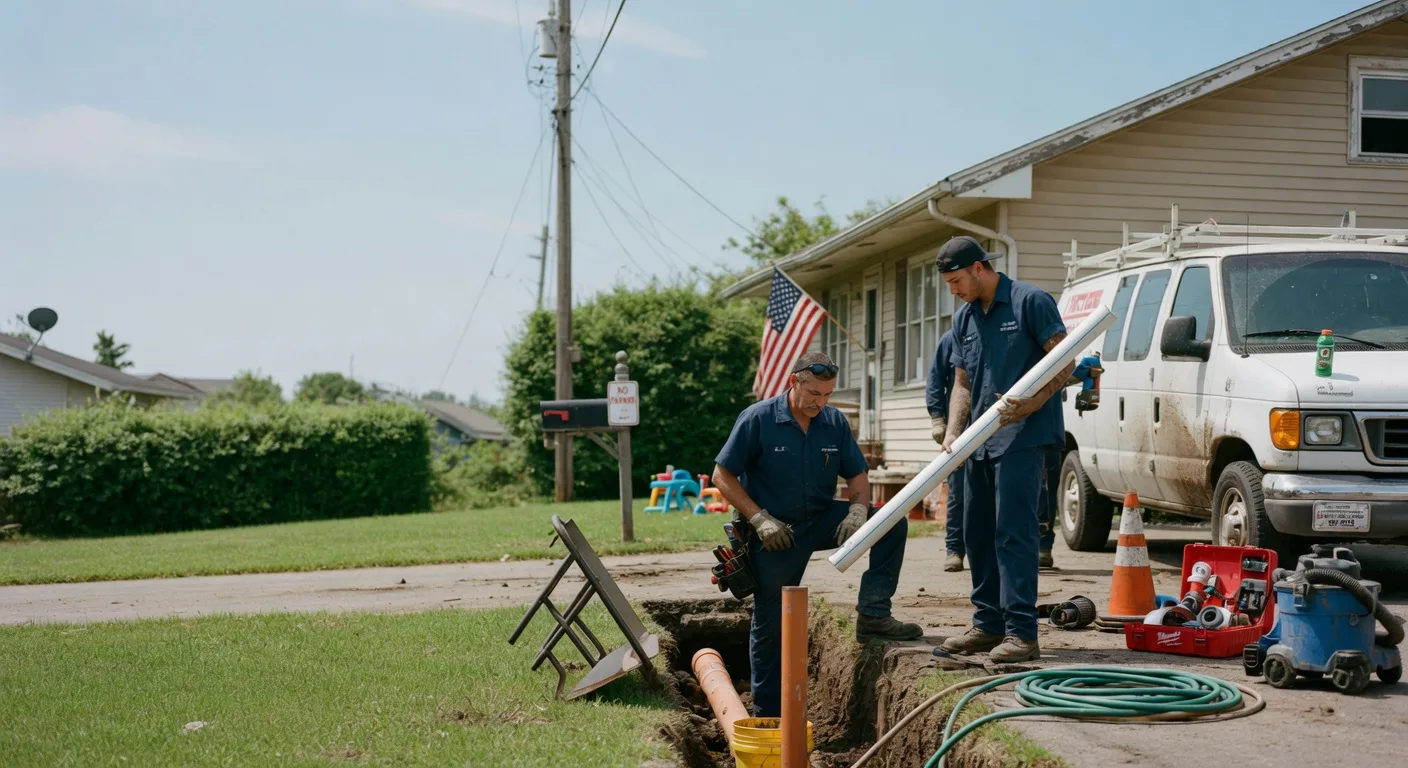
What does it mean if the cable machine stops at the same distance every time?
The cable stops dead at the same spot every time, and the plumber says it feels like a wall. That tells you the problem is fixed in one place. It is not a soft blockage that moves.
Common causes are tree roots that have grown in at a clay pipe joint, a section that has dropped or cracked, or a bellied line where the pipe sags and holds water. It can also be a bad coupling where one pipe no longer lines up with the next. A cable can punch through roots or grease, but it cannot get past a pipe that has shifted or broken.
Note the distance the cable went in. That number tells the next plumber where to look, and whether the fault is inside the house or out in the yard.
Safe homeowner check: if only one fixture is slow, go easy on water and note which drain it is. Stop running water and call now if several drains back up, if water comes up in a tub or floor drain, or if there is a sewage smell indoors.
A camera inspection is the right next step, because it shows what the cable hit. Roots or heavy grease may clear with hydro jetting. A broken or bellied pipe is a repair, and the cost depends on access, how much has to be dug or opened, the materials, and any permit required. Expert Plumbers Co is a referral service. Call (380) 262-9173 and we will connect you with a plumber in Williston, ND for Drain Cleaning.
Mark the spot where the stoppage sits if the cleanout or access point makes that possible, and tell the plumber whether the line runs under a slab, a driveway or a lawn. That decides how the repair is approached and how much has to be opened up. In older homes, the stoppage is often a clay joint that has been invaded by roots or has slipped, and the fix may be a spot repair on one section instead of replacing the whole run. In newer homes a stop at the same distance is more often a poorly set joint or a fitting that was installed out of line. After the camera has found the fault, ask for the footage or a few stills. They show the pipe material, the condition on either side of the problem and whether other weak points are coming. Until the repair is done, expect the line to clog again, so keep water use low and avoid putting anything but waste and paper into it.
Water or sewage is seeping out around the cleanout cap in my yard. What does that mean?
If liquid is seeping up around the cleanout cap, the sewer line is full to ground level at that point. The cleanout is a capped pipe that gives a plumber direct access to the main line, and it is often the lowest open point on the system. When a blockage sits downstream, waste water rises until it finds the weakest spot, and that is frequently the cap.
Less often the cap itself is the problem: a cracked cap or worn threads can weep a little after heavy use. The difference is the smell and the timing. A damp ring with no odor that dries out is one thing. Grey or dark water with a sewage smell that returns every time the house uses water points to a blocked or partly collapsed line.
Look at the rest of the house. If one fixture is slow, the trouble may be local. If several drains are slow, toilets gurgle, or a floor drain or shower fills when the washer runs, the main line is the likely culprit.
Safe checks you can do:
Keep children and pets away from the wet area. Hold off on laundry, dishwasher cycles and long showers. Do not unscrew the cap. A line under pressure can spray sewage when the cap comes off, and that is a health risk.
Stop running water and call now if sewage is reaching the yard in a steady flow, if it is entering the house, or if the seep keeps growing while you are using as little water as possible.
On the repair side, a cable machine is often enough for a soft blockage such as paper or grease. Roots, heavy grease build-up or scale usually call for hydro jetting or a cutting head. A camera inspection afterwards shows whether the pipe is cracked, bellied or offset at a joint, which decides whether cleaning will hold or whether a repair is needed. Cost depends on how easy the cleanout is to reach, how far the blockage sits from it, how much needs to be dug or removed if a repair follows, and permit requirements under local code.
If the line has to be opened for repair, the local building department may need to be involved. To be connected with an independent local plumber in Williston, ND, call Expert Plumbers Co on (380) 262-9173.
Can a drain cable or hydro jetting damage old pipes like cast iron, clay or thin-wall pipe?
Yes, it can, and a good plumber knows that before the machine is switched on. Old pipe is not equally fragile everywhere, and the choice of tool depends on what the pipe is made of and what shape it is in.
Cable machines spin a cutting head against the pipe wall. In sound pipe that is fine. In clay with offset joints, the head can catch on a lip and snag. In cast iron with heavy scale, a cutting head can knock loose flakes, and in a pipe already thinned by corrosion it can punch through. Thin-wall plastic or older Orangeburg-type fiber pipe can be gouged or deformed.
Hydro jetting pushes water at high pressure through a nozzle. On solid pipe it cleans the walls better than a cable. On a cracked clay pipe, a corroded cast iron stack, or a joint that has already shifted, that pressure can widen the damage or send water out into the soil.
So how does the plumber decide? Usually from several clues:
The age and material of the house and the pipe, which tells the plumber what to expect.
Past history, such as repeated roots, earlier repairs, or a line that has never been inspected.
How the cable behaves. A head that bounces, stops at the same distance, or comes back with pipe chips or rust flakes suggests the pipe itself is damaged.
A camera look first. This is the most direct answer. If the line is fragile or offset, the plumber can choose a gentler head, lower pressure, or no jetting at all.
If you suspect old pipe, say so on the phone. Tell the plumber the age of the house and the pipe material if you know it. Ask whether the tool will be matched to the pipe, and whether a camera look comes first.
Sometimes the honest answer is that a quick clearing is worth the risk to get water moving, with a plan to inspect afterward. Sometimes it is not. Either way, the decision should be explained to you before the work starts, not after.
If you need a drain cleared in Williston, ND, Expert Plumbers Co can connect you with an independent local plumber at (380) 262-9173.
The outdoor drain by my driveway, patio or basement stairwell floods in heavy rain. Who clears that?
"The drain by my driveway floods every time it rains hard." Outdoor drains at driveways, patios and basement stairwells fail in heavy rain because they are built to move a lot of water quickly, and leaves, silt and gravel stop that. The grate clogs, then the pipe below fills.
The first thing to know is where it goes. Many exterior area drains tie into a storm line or a dry well, not the sanitary sewer. Some connect to the house drain, and rules vary by area on whether that is allowed. Where the pipe ends decides who can service it, what tools make sense and whether a permit is involved.
Common causes are packed leaves and silt in the drain body, a pipe crushed or shifted by a root or vehicle, tree roots entering a joint, a pipe with too little fall so it holds water, and a storm line that is full or backed up downstream. In a stairwell, the pipe often runs to a lower point and can clog with mud.
If one outdoor drain floods and the rest of the house drains normally, the blockage is in that outdoor branch. If basement floor drains and toilets back up in the same storm, the drain may be tied to the house drain or the main line is overloaded. Check which, because that changes the repair.
Safe homeowner check: Take the grate off and clear leaves and debris by hand with gloves. Look into the drain with a light. Pour a bucket of water in and watch if it drains or stands. Note whether the problem happens only in heavy rain. Do not stand in standing water near electric outlets, and do not poke the pipe with a rod that could crack it.
Stop running water and call now if water is entering the house through a door or foundation, a basement drain is rising, sewage smell comes with the flooding, or the water backs up into indoor fixtures.
A cable machine can clear soft debris and some roots. Hydro jetting is better for packed silt and fine roots in a longer run. A camera inspection helps when the drain keeps flooding, because it shows a collapsed section, a belly holding water, or where the line actually discharges.
Expert Plumbers Co is a referral service. We connect you with an independent local plumber in Williston, ND. Call (380) 262-9173.
Ask the plumber where the drain discharges and whether it can be reached with a cleanout. Ask whether a repair or regrading is needed, not just clearing. Cost depends on access, the parts or materials needed, how much of the paving or soil has to be opened up or removed, and any permit or code requirement.
Will baking soda and vinegar, or a kettle of boiling water, clear a slow drain?
You have a slow drain, so you tried baking soda and vinegar, or a kettle of boiling water. It still crawls, or the clog is back by morning. That is the usual result.
The fizz is mild. It can freshen a drain, but it does nothing to a solid clog of hair, soap scum, grease or paper. Boiling water melts grease for a moment, then the grease cools and sets again further down the pipe, where it is harder to reach. Boiling water can also soften PVC joints and crack porcelain. Hot tap water is safer than a kettle.
The real causes sit deeper: grease build-up on the pipe wall, scale in old cast iron, roots entering a clay joint on the main, or a bellied line that holds water and solids at its low point. A blocked vent stack can also make a drain sluggish and gurgling, which looks like a clog but is an air problem.
Count the affected drains. One slow fixture usually means a hair, soap or grease clog in that fixture or its branch. If the tub, sinks and toilets all run slow together, or you hear gurgling after a flush, the trouble is in the main line or vent, and no kitchen remedy will reach it.
Safe homeowner check: Remove the stopper or strainer and clear hair and residue by hand. Try a plunger with a good seal. Run hot tap water, not boiling. Check whether other fixtures are slow. Avoid stacking store-bought chemical cleaners, which can sit in a standing pipe.
Stop running water and call now if more than one fixture is backing up, if dark water is rising in a tub or floor drain, if you smell sewage, or if water comes up when you flush or drain the washer.
A cable machine is usually enough for a clog in a single branch. Hydro jetting is the better tool when grease or scale coats the pipe wall. A camera inspection is the right step when the drain clears and slows again within days, since that pattern points to a belly, roots or a damaged section.
Expert Plumbers Co is a referral service. We connect you with an independent local plumber in Williston, ND. Call (380) 262-9173.
Tell the plumber what you already tried. Ask what they found in the line, not only that it was cleared. The scope depends on access to the pipe, whether a fixture has to be removed, the pipe material, and whether the cause is a simple clog or damage that needs repair.